Software Testing Analysis & Review Review


Software Testing Analysis & Review Review


Campus calendaring systems help keep the college community involved, informed.(Industry Perspective): An article from: T H E Journal (Technological Horizons In Education) Review
This digital document is an article from T H E Journal (Technological Horizons In Education), published by T.H.E. Journal, LLC on August 1, 2003. The length of the article is 1630 words. The page length shown above is based on a typical 300-word page. The article is delivered in HTML format and is available in your Amazon.com Digital Locker immediately after purchase. You can view it with any web browser.
Citation Details
Title: Campus calendaring systems help keep the college community involved, informed.(Industry Perspective)
Author: Andrew Sherman
Publication: T H E Journal (Technological Horizons In Education) (Refereed)
Date: August 1, 2003
Publisher: T.H.E. Journal, LLC
Volume: 31 Issue: 1 Page: 34(3)
Distributed by Thomson Gale
Advanced Options Trading: Approaches, Tools, and Techniques for Professionals Traders Review

As an active trader in today’s market, you are faced with unprecedented challenges. Dramatic price swings in equity, debt, and currency have made it tougher than ever to manage and trade risk. But with great risk, of course, comes great opportunity— and Advanced Options Trading delivers a detailed system for successfully trading options in a highly volatile and unpredictable global market.
Noted options educator and owner of his own brokerage house, Kevin M. Kraus explains the best practices for using options to capture premium, reduce equity purchase prices, manage the costs of buying options, and control portfolio risk—critical skills for finding steady profits in our ever-shifting economic landscape. He offers a close examination of the nature of volatility and what it means for investors, whether they’re just getting started or are veterans of the options market.
Advanced Options Trading covers:
Options are among the most valuable tools for hedging and risk management, and they also function as profitable investment vehicles, allowing you to make bearish trades through radical market shifts.
Advanced Options Trading provides a solid foundation on the options market, along with the necessary skills for trading and managing risk in today’s constantly expanding and contracting market.
Risk Analysis: A Quantitative Guide Review
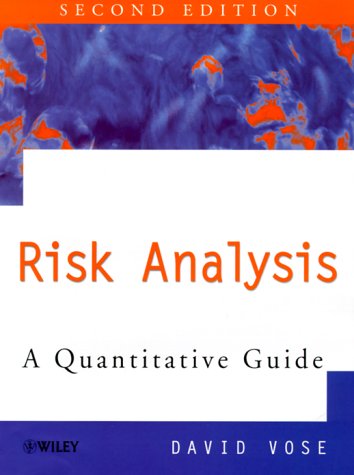
Risk Analysis A Quantitative Guide Risk and uncertainty are key features of most business and government problems and need to be understood for rational decisions to be made. This book concerns itself with the quantification of risk, the modelling of identified risks and how to make decisions from those models. Following on from the success of the previous edition of this clearly written and highly regarded book, this edition is extensively revised and updated and will provide an invaluable practical guide for beginners and experienced practitioners alike. Quantitative risk analysis (QRA) using Monte Carlo simulation offers a powerful and precise method for dealing with the uncertainty and variability of a problem. By providing the building blocks the author guides the reader through the necessary steps to produce an accurate risk analysis model and offers general and specific techniques to cope with most modelling problems. A wide range of solved problems is used to illustrate these techniques and how they can be used together to solve otherwise complex problems. Reviews of the first edition "It identifies the various facets of risk analysis and provides a valuable reference to the concepts and techniques employed." Project, 1997 "It clearly explains many essential aspects of quantitative risk analysis . provides valuable techniques and sound professional advice." Journal of Behavioral Decision Making, Vol. 12, 1999 "The book offers a powerful method for dealing with risk and uncertainty." Zentralblatt für Mathematik, Band 908, 1999
Using CFD capabilities of CONTAM 3.0 for simulating airflow and contaminant transport in and around buildings.(Report): An article from: HVAC & R Research Review
This digital document is an article from HVAC & R Research, published by American Society of Heating, Refrigerating, and Air-Conditioning Engineers, Inc. on November 1, 2010. The length of the article is 6098 words. The page length shown above is based on a typical 300-word page. The article is delivered in HTML format and is available immediately after purchase. You can view it with any web browser.
From the author: CONTAM is a multizone building airflow and contaminant transport computer program often used for ventilation and indoor air quality analysis. The program was recently enhanced to incorporate CFD capabilities for both outdoor and indoor environmental analysis. This paper introduces the CFD features implemented within the most recent version, CONTAM 3.0. The outdoor or external CFD link predicts wind pressure coefficients and contaminant concentrations for airflow paths at the building surface. A converter computer program translates the wind pressure coefficients to the CONTAM data format. This external CFD link is useful for parametric studies of the impact of outdoor air quality on indoor environment when considering different wind directions or contaminant locations, especially simulations under transient conditions. The ability to embed a single CFD zone in a CONTAM network model has also been implemented. This enables the detailed modeling of a zone when the well-mixed multizone assumption is not appropriate and then uses the multizone approach for the rest of a building, thus capturing the local distribution of air and contaminant properties in a zone and their impacts on other zones of a building. CFD capabilities are demonstrated using a generic residential house model to show how these two new CFD features enhance the existing CONTAM capabilities for both indoor and outdoor air quality analysis.
Citation Details
Title: Using CFD capabilities of CONTAM 3.0 for simulating airflow and contaminant transport in and around buildings.(Report)
Author: Liangzhu (Leon) Wang
Publication: HVAC & R Research (Magazine/Journal)
Date: November 1, 2010
Publisher: American Society of Heating, Refrigerating, and Air-Conditioning Engineers, Inc.
Volume: 16 Issue: 6 Page: 749(15)
Article Type: Report
Distributed by Gale, a part of Cengage Learning
A novel algorithmic cost estimation model based on soft computing technique.: An article from: Journal of Computer Science Review
This digital document is an article from Journal of Computer Science, published by Science Publications on February 1, 2010. The length of the article is 5400 words. The page length shown above is based on a typical 300-word page. The article is delivered in HTML format and is available immediately after purchase. You can view it with any web browser.
From the author: Key words: Software project management, software cost estimation models, COCOMO II, soft computation model, fuzzy logic
Citation Details
Title: A novel algorithmic cost estimation model based on soft computing technique.
Author: Iman Attarzadeh
Publication: Journal of Computer Science (Magazine/Journal)
Date: February 1, 2010
Publisher: Science Publications
Volume: 6 Issue: 2 Page: 117(9)
Distributed by Gale, a part of Cengage Learning
Nondestructive detection of termites using a millimeter-wave imaging technique.: An article from: Forest Products Journal Review
This digital document is an article from Forest Products Journal, published by Thomson Gale on October 1, 2007. The length of the article is 3248 words. The page length shown above is based on a typical 300-word page. The article is delivered in HTML format and is available in your Amazon.com Digital Locker immediately after purchase. You can view it with any web browser.
Citation Details
Title: Nondestructive detection of termites using a millimeter-wave imaging technique.
Author: Yoshihisa Fujii
Publication: Forest Products Journal (Magazine/Journal)
Date: October 1, 2007
Publisher: Thomson Gale
Volume: 57 Issue: 10 Page: 75(5)
Distributed by Thomson Gale
